

Agricultural Sales
Purpose
The purpose of the FFA Agricultural Sales Career Development Event is to evaluate and demonstrate skills that are essential for an individual to be successful in the agricultural sales career. Students will also develop an understanding of the opportunities available in the sales industry. The process of selling agricultural products is essential for the production and marketing of agricultural products.
Objectives
The agricultural sales career development event provides the opportunity for the participant to:
- Develop verbal, written and interactive communication skills.
- Demonstrate skills to build rapport with customers.
- Discuss features and benefits of a product.
- Identify potential customer objections.
- Introduce the product to prospective customers.
- Develop a sales call that determines and addresses customers’ needs and objections.
- Attempt to close the sale by asking for a customer’s buying decision.
- Identify and demonstrate the use of questions throughout the sales process.
- Develop active listening skills.
Event Rules
- The team will be composed of four students, and all four individual scores will count toward the team total.
- FFA Official Dress is required for this event.
- Contestants will be allowed to have a personal calculator with them during the written test, but NOT in other parts of the contest. Any participant in possession of an electronic device, except a calculator, in the event area is subject to disqualification.
- Additional notes, books, or paper will not be allowed in the contest room.
- Business cards are not permitted and will not contribute to the individual or team scores.
Event Format
The event will be composed of three parts. Individual scores will be composed of the written exam and individual sales activity. The team score will be comprised of the team activity and all individual scores.
The product(s) utilized in the event and activity examples will be posted prior to
the event on the OSU CDE webpage. Provided product information may include appropriate company information and price
list.
Each participant will be allowed to bring a 1-inch binder to the event containing
the provided product information and any other information gathered by the participant.
- Equipment
- The written examination scan sheet will be provided by the contest superintendent. All other equipment will be provided by the contestant, including a calculator and pencil.
- Event Schedule
- Each contestant shall complete the event in the time allotted:
- Written Exam - 30 minutes
- Team Activity - 40 minutes
- Individual Activity - 20 minutes
- Each contestant shall complete the event in the time allotted:
- Individual Written Exam - 100 points
- The written exam is designed to evaluate an individual’s knowledge of sales skills. The questions will be obtained from the previous questions used in National FFA competition. There will only be multiple choice questions. The test will consist of twenty-five (25) questions worth four (4) points each.
- All questions will be multiple choice.
- Students will answer using a scantron sheet; only answers filled in on the scantron sheet will be counted. Point values will be assigned to each question based on the skill level of the question.
- Bringing a calculator is strongly encouraged for this part of the contest (although calculators are not permitted in the other parts of the contest).
- Team Activity - 150 points
- Team members will work together to demonstrate teamwork, group dynamics, problem-solving, data analysis, decision making and oral communications.
- Teams will be allowed to use their 1-inch binder for the event.
- The following information will be provided to the team as if they were a group of
salespeople working together to develop the pre-call planning prior to conducting
a sales call.
- Product information (see below).
- Profiles of different customers (at the event).
- Paper and pencils. No presentation equipment such as laptops, flipcharts or dry erase boards will be allowed.
- Teams will be allocated a 20-minute period to examine the provided information and prepare responses to potential questions regarding the pre-call plan. The preparation phase will not be judged.
- Each team is required to present their sales plan to the judges within a 10-minute timeframe, ensuring participation from all team members. Following the presentation, judges will have 10-minutes to ask questions to the team members.
- Students must articulate the rationale behind their decisions in the pre-call plan, basing their explanations on established selling principles.
- Individual Sales Activity - 150 points
- Information and product(s) from team activity will be used in the individual sales
activity. (Individual activity will be conducted after the team activity).
- Participants will meet with a judge who will be playing the role of one of the four hypothetical customers profiled in the team activity.
- Participants are to implement their strategy for developing a rapport with the customer and determine which of the four hypotherical customers the judge is role playing.
- The judge(s) will act as the customer, which may include not buying the product. Participants will have to establish rapport, ask probing questions to ensure they meet the customer’s needs and clarify customer information as a part of the sales call.
- Participants will have 20 minutes to interact with the judge(s). Participants are allowed to use their 1-inch product information binder during the individual activity.
- Information and product(s) from team activity will be used in the individual sales
activity. (Individual activity will be conducted after the team activity).
Scoring
| Activities | Individual Points | Team Points |
|---|---|---|
| Written Exam | 100 | 400 |
| Team Activity | - | 150 |
| Individual Sales Call | 150 | 600 |
| Maximum Points | 250 | 1,150 |
Tiebreakers
Individual
In the event of a tie in individualized scores, the following events will be used to determine award recipients:
- Written exam.
- Individual sales call.
- Team activity.
Team
In the event of a tie in team scores, the following events will be used to determine award recipients:
- Written exam.
- Team activity.
- Total individual sales activity.
Product Information
This year, students will assume they work for the TLC Garden Center in Oklahoma City, and all your potential customers are new homeowners in the state of Oklahoma. Their newly built home currently has no trees. They are looking for at least one tree, maybe more, to plant in their yard. You have 14 types of trees you sell, with their attributes shown below.
About trees for homeowners:
- When homeowners are shopping for trees they will consider the following attributes:
- The size of the tree, in both its height and spread.
- Whether they want room underneath the tree for activities, like picnicking in the shade.
- Whether they want the tree to bear edible fruit.
- The color of any flowers it might have.
- Whether they want a deciduous or evergreen tree.
- If the tree can grow given the condition of the homeowner’s yard (e.g., does the soil drain well or can it get soggy?).
- Leaf colors.
- How fast the tree grows.
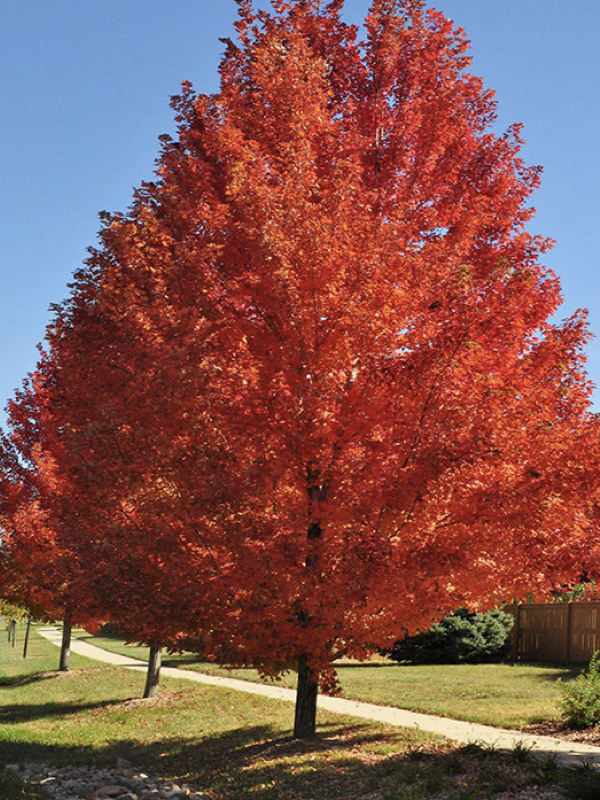
Autumn Blaze Maple
The Facts
-
-
Height: 40-55"
-
Spread: 30-40"
-
Sun: Full sun to part shade
-
Water: Medium
-
Soil: Well-drained
-
Growth Rate: Fast
-
Price in $ / 10 gallon container: $179
-
‘Jeffersred’, sold under the trade name of ‘Autumn Blaze’, is an older cultivar that was discovered by nurseryman Glenn Jeffers in the late 1960s. This is an upright, fast-growing, deciduous tree that will typically grow 40-55’ tall with ascending branching and a dense, broad-oval crown. Its growth rate tends to exceed other maples. Each medium green leaf is deeply cut with five pointed lobes.
As the trade name suggests, the foliage turns into an autumn blaze of orange-red to scarlet-red fall color and persists longer than other cultivars. Flowers and fruit for this hybrid are very sparse. A favorite for any neighborhood or landscape. Its fall color is the perfect show to wow.
Bald Cypress
The Facts
-
-
Height: 50-70'
-
Spread: 20-45'
-
Sun: Full sun
-
Water: Medium to wet
-
Soil: Well-drained
-
Growth Rate: Fast
-
Price in $ / 10 gallon container: $179
-
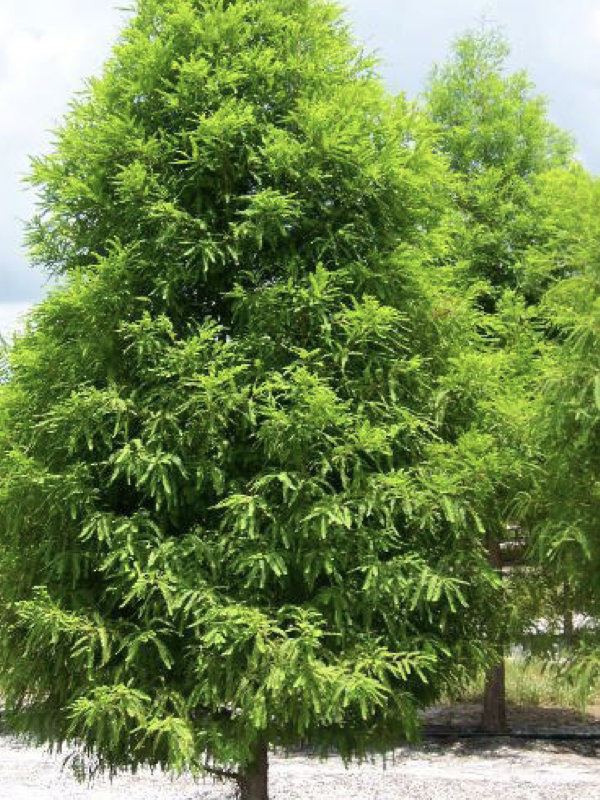
Bald cypress is a long-lived, pyramidal conifer. Although it looks like a needled evergreen (same family as redwoods) in summer, it is deciduous (“bald” as the common name suggests). It is native to southern swamps, bayous and rivers, primarily being found in coastal areas from Maryland to Texas and in the lower Mississippi River valley to as far north as the southeast corner of Missouri.
In the deep South, it is a familiar sight growing directly in swampy water, often in large stands, with its branches heavily draped with Spanish moss. In cultivation, however, it grows very well in drier, upland soils. Trunks are buttressed (flared or fluted) at the base, and when growing in water, often develop distinctive, knobby root growths (“knees”) which protrude above the water surface around the tree. Soft, feathery, yellowish-green foliage turns an attractive orange/cinnamon-brown in fall. Rounded, wrinkled, 1 inch diameter, purplish-green cones mature to brown. Heavy, straight-grained, rot-resistant wood has been used for a variety of purposes including barrels, railroad ties and shingles. Taxodium in Greek means resembling yews (Taxus) in reference to the flat needles.
Blue Atlas Cedar
The Facts
-
-
Height: 40-50'
-
Spread: 20-25'
-
Sun: Full sun
-
Water: Medium
-
Soil: Well-drained
-
Growth Rate: Very slow
-
Price in $ / 10 gallon container: $225
-
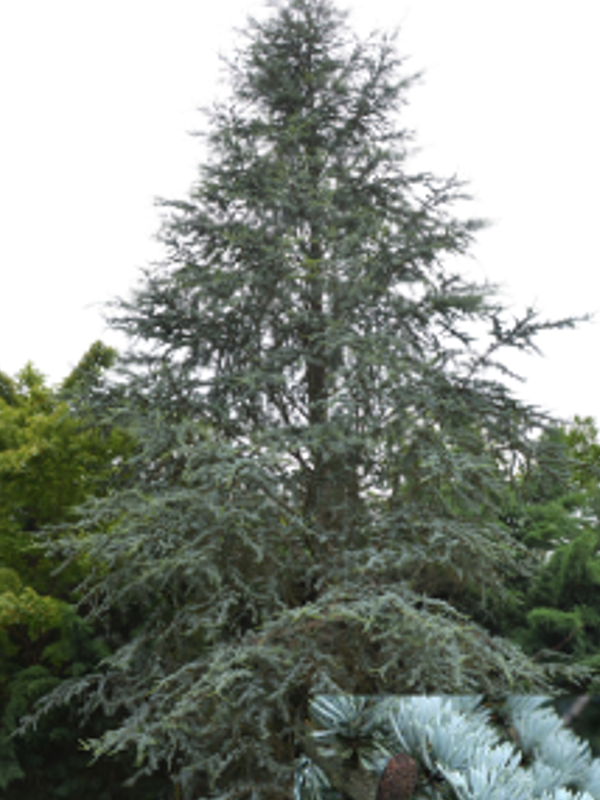
This highly coveted tree is truly one-of-a-kind. The Blue Atlas Cedar can be found in its natural habit in the Atlas Mountains in northwest Africa. The tree’s silvery blue to bluish-green needles, about 1 1/2” long, can be stiff and clustered. Once it’s started to hit its stride, the Blue Atlas produces barrel-shaped male cones that are about 2-3” long on the lower branches; browning, from green, over a period of two years. Like with any needled evergreen it will shed from time to time, but this occurrence is nothing to worry about.
The Blue Atlas is sought out for its unique color and its pyramidal growth habit. The natural aromatic oil it produces is also a large attractant for the species. When given enough space to grow freely, it can truly be used as grand statement piece in any landscape.
Blue Ice Arizona Cypress
The Facts
-
-
Height: 30'
-
Spread: 12'
-
Sun: Full sun
-
Water: Medium
-
Soil: Well-drained
-
Growth Rate: Fast
-
Price in $ / 10 gallon container: $249
-
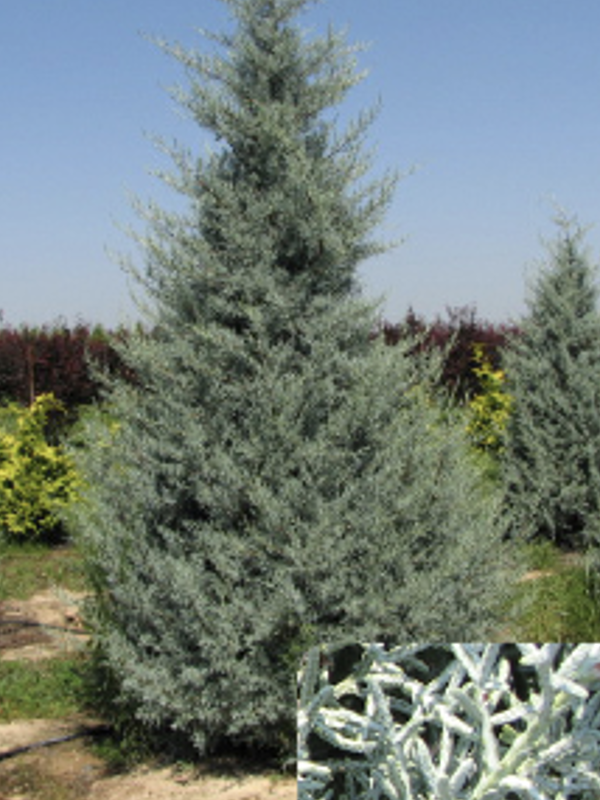
This native evergreen makes a dramatic focal point in any sunny location. Its intense powdery blue, scale-like needles that are soft to the touch and upright tight pyramidal form screams from far distances drawing the curious onlooker closer for a more detailed inspection. It produces chocolate brown globular cones. When mature, the exfoliating bark adds interesting texture to your landscape.
Blue Ice Arizona Cypress adds great color contrast and excitement to the landscape and is becoming more popular in the southern regions for year round color and screening potential.
Canada Red Chokeberry
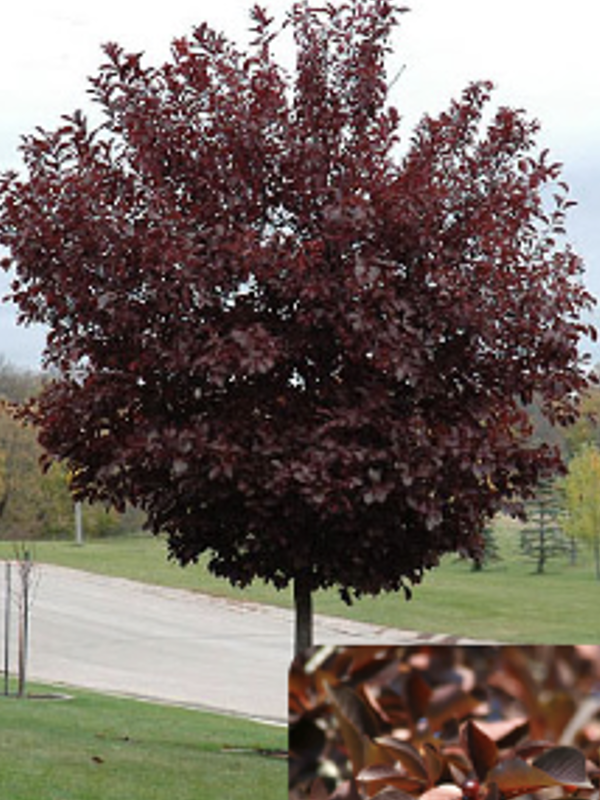
The Facts
-
-
Height: 20-30'
-
Spread: 15-20'
-
Sun: Part to full sun
-
Water: Medium
-
Soil: Well-drained
-
Growth Rate: Moderate
-
Price in $ / 10 gallon container: $179
-
This tough, hardy and colorful ornamental chokecherry is the perfect choice for tough spots to grow in. Its most notable and unique feature are its first emerging lush and green leaves turning bright reddish purple in early summer. The new growth later in the season adds color and texture among the already turned leaves.
The Canada Red features arching branches that develop an evenly rounded crown. This gives the tree a nice silhouette against the winter sky during dormancy. Even highly astringent, the small fruit produced after flowering is sometimes used in jams and preserves. Its beautiful shape and attractive coloring make this tree a superb choice for a street or lawn tree. Its versatility make it a great choice for this or in mass plantings in open spaces as well.
Canaerti Juniper
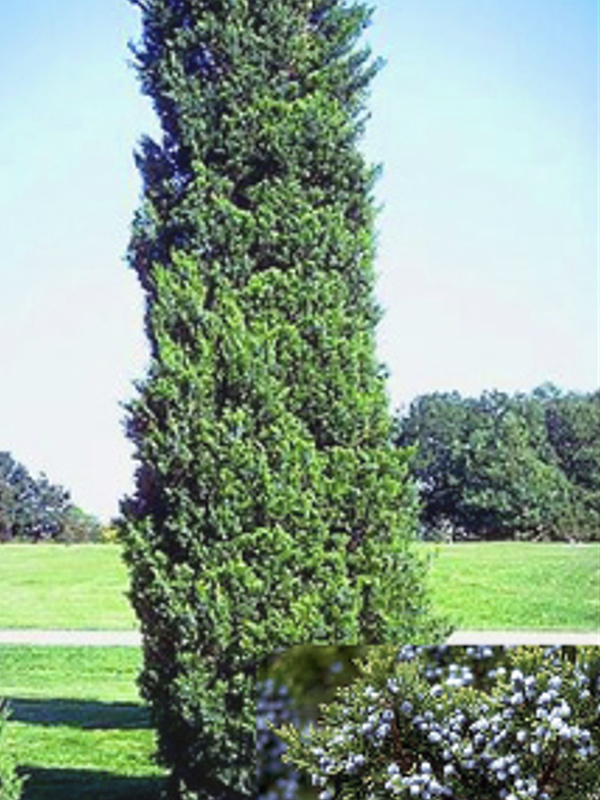
The Facts
-
-
Height: 20-35'
-
Spread: 8-15'
-
Sun: Full sun
-
Water: Medium
-
Soil: Well-drained
-
Growth Rate: moderate
-
Price in $ / 10 gallon container: $166
-
These lustrous junipers, native to Missouri, are often found in Oklahoma as screens; whether for privacy or for wind. An excellent choice as Canaertii is a female variety that produces round, blue, berry-like cones (1/4” diameter) with whitish bloom. Cones are often profuse and are considered to be highly ornamental.
This juniper is a broadly conical, sometimes columnar, dense, evergreen conifer with horizontal branching. Gray to reddish-brown bark exfoliates in thin shoddy strips on mature trees. Trunks are often fluted at the base. ‘Canaertii’ is a compact pyramidal cultivar with ascending branching. Shape opens up and becomes more irregular as plants age. Dark green foliage is mostly scale-like (adult) with awl-like (juvenile) needles on young branches. Foliage generally retains good green color in winter.
Cedar Elm
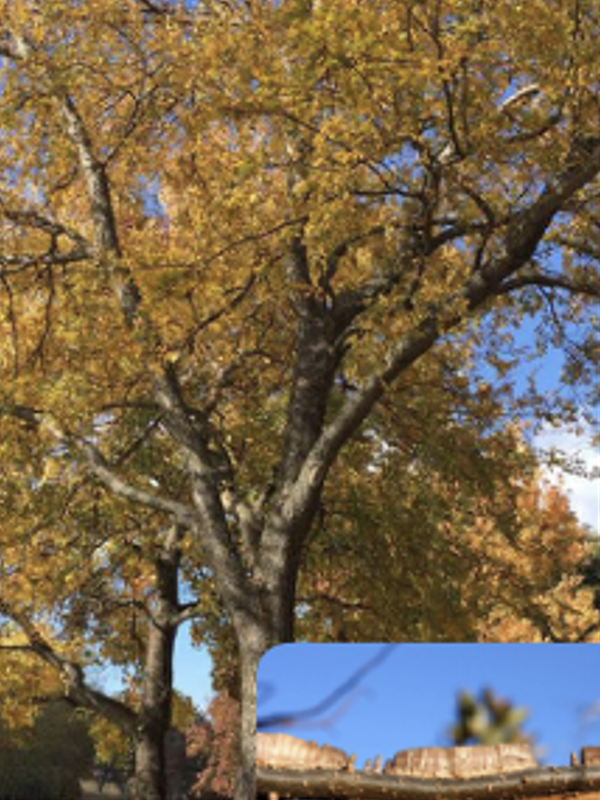
The Facts
-
-
Height: 50-70'
-
Spread: 40-60'
-
Sun: Full sun
-
Water: Medium
-
Soil: Well-drained
-
Growth Rate: Moderate
-
Price in $ / 10 gallon container: $139
-
The Cedar Elm, or Ulmus crassifolia, has long been a traditional favorite in the south. Its wide adaptability makes it a very popular choice as it can tolerate a number of soil and atmospheric conditions. This tree is selected not only for its adaptability, but for its regal beauty as well. Featuring lustrous, dark green leaves that are 1 - 2” and small clusters of light-green blooms in late summer, this tree is a statement in any landscape. It’s rounded and slightly vase shape help accent this towering specimen. The golden-yellow fall foliage fades to a warm copper color, adding the perfect touch to the autumn atmosphere. Its dominating form and drooping branches, with their corky ridges, add beautiful texture and an eye-catching silhouette to the winter landscape.
Chinese Pistache
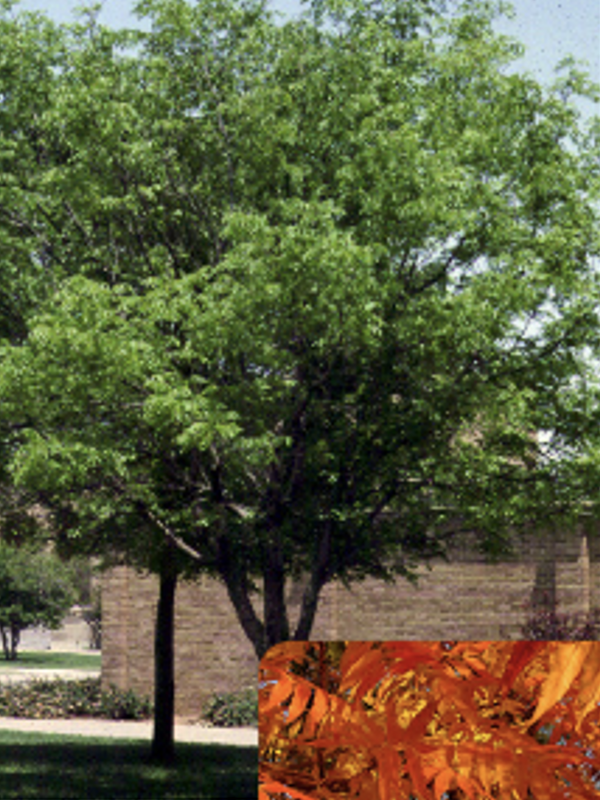
The Facts
-
-
Height: 30-35'
-
Spread: 20-30'
-
Sun: Full sun
-
Water: Dry to medium
-
Soil: Well-drained
-
Growth Rate: Fast
-
Price in $ / 10 gallon container: $159
-
Pistacia chinensis, or Chinese Pistache, is fast growing to be a favorite in Oklahoma. Though called the “Ugly duckling” of the tree world because of its sometimes shape in its youth, this tree grows into one of the most beautifully shaped trees around. Its canopy becomes rounded and arched on top leaving it flat underneath giving you a sense of connection to nature and your surroundings.
Foliage consists of compound, even-pinnate, dark green leaves (to 10” long), each leaf typically having 10–12 lanceolate leaflets (to 4” long). Foliage is aromatic when bruised. Fall color is variable but often appears in quality shades of yellow, orange and red. Trees are dioecious (separate male and female trees), with flowers appearing in April in visible but somewhat inconspicuous green panicles. Gray-brown bark peels to reveal salmon inner bark.
Debonair Pond Cypress
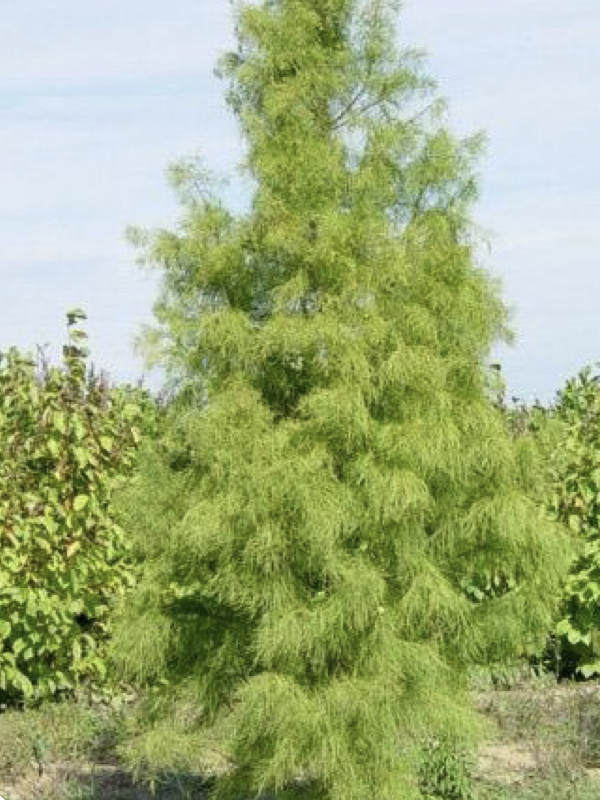
The Facts
-
-
Height: 50'
-
Spread: 10-12'
-
Sun: Full sun
-
Water: Medium to wet
-
Soil: Well-drained
-
Growth Rate: Moderate to fast
-
Price in $ / 10 gallon container: $395
-
Here is a relatively new variety of Pond cypress that is a study in contrast. There are few trees as tough as a pond cypress. They can withstand drought, total immersion, deep hard winter and endless sweltering summers.
Few conifers have such delicate, feathery foliage. These ‘needles’ practically beg for a caressing touch and the Pond cypress cultivar ‘Debonair’ has the most delicate of all. This foliage has a languid drape of long green threads that waft in the slightest breeze. The medium green color is also attractive especially since it hangs from cinnamon colored stems. And it turns a rich russet orange in autumn. Unlike the bald cypress, the ‘Debonair’ pond cypress might reach 50’ tall, but has a narrow spread of 10–12’. This gives the tree a narrow, oval shape that adds to its striking stature.
Golden Raintree
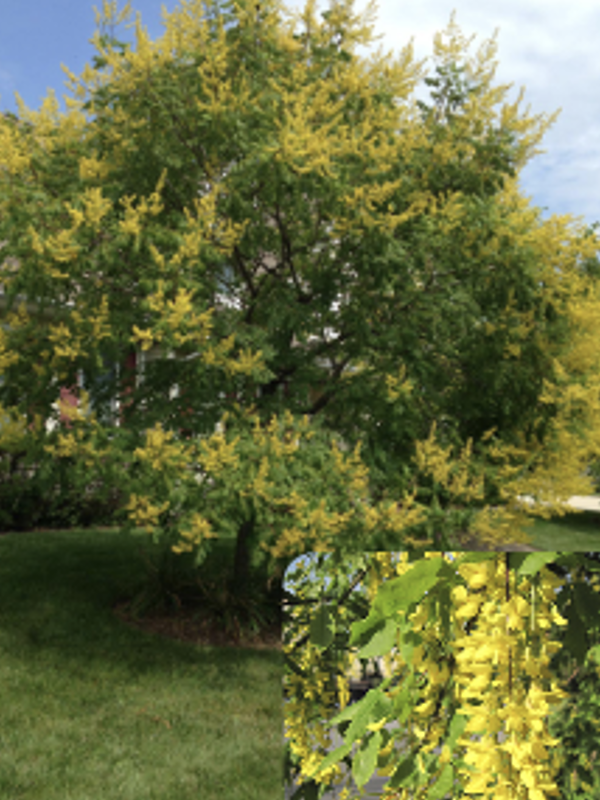
The Facts
-
-
Height: 30-40'
-
Spread: 30-40'
-
Sun: Full sun to part shate
-
Water: Dry to medium
-
Soil: Well-drained
-
Growth Rate: Fast
-
Price in $ / 10 gallon container: $179
-
Goldenraintree is a small, open-branching, irregularly-shaped, deciduous tree with a rounded crown. Features pinnate or bipinnate, feathery, compound leaves (to 18” long), each leaf having 7–17 irregularly lobed leaflets. Leaves emerge pinkish bronze to purplish in spring, mature to a bright green in summer and turn yellow (quality variable) in fall. Bright yellow flowers (1/2” wide) appear in early summer in long, terminal, panicles (12–15”). Falling blossoms may or may not resemble “golden rain”, but the fallen blossoms often form an attractive golden carpet under the tree. Flowers give way to interesting, brown, papery seed capsules which somewhat resemble Chinese lanterns.
Princeton Elm
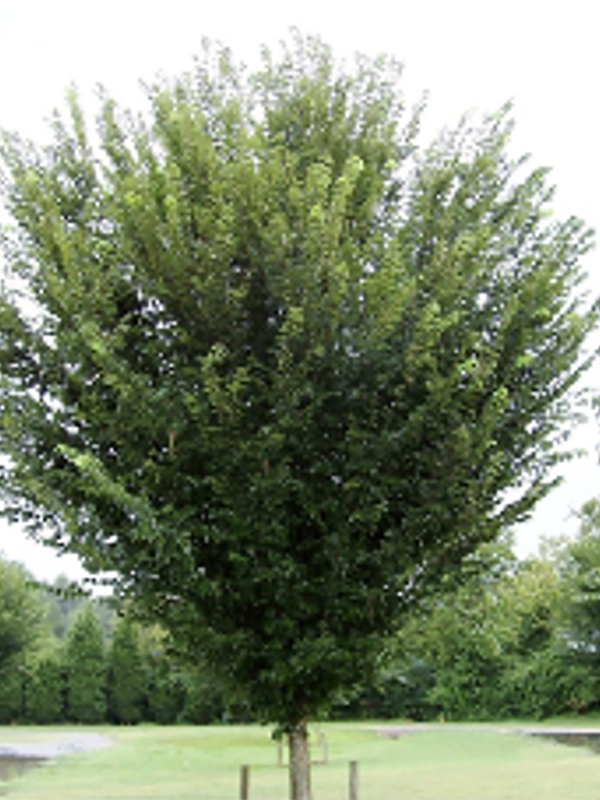
The Facts
-
-
Height: 60-80'
-
Spread: 30-40'
-
Sun: Full sun
-
Water: Medium
-
Soil: Well-drained
-
Growth Rate: Fast
-
Price in $ / 10 gallon container: $279
-
These true American elms are nothing but grace and beauty with their upright vase-shaped growth habit. The shape of this tree is very fluid as it matures. It grows quickly at 4 to 6 feet per year.
The foliage features large leathery dark green in summer and a beautiful yellow in fall; great variation in intensity of fall coloration. This tree has proven resistant to Dutch elm disease and is easily planted anywhere as the root system is very fibrous and shallow.
Vitex (Chaste Tree)
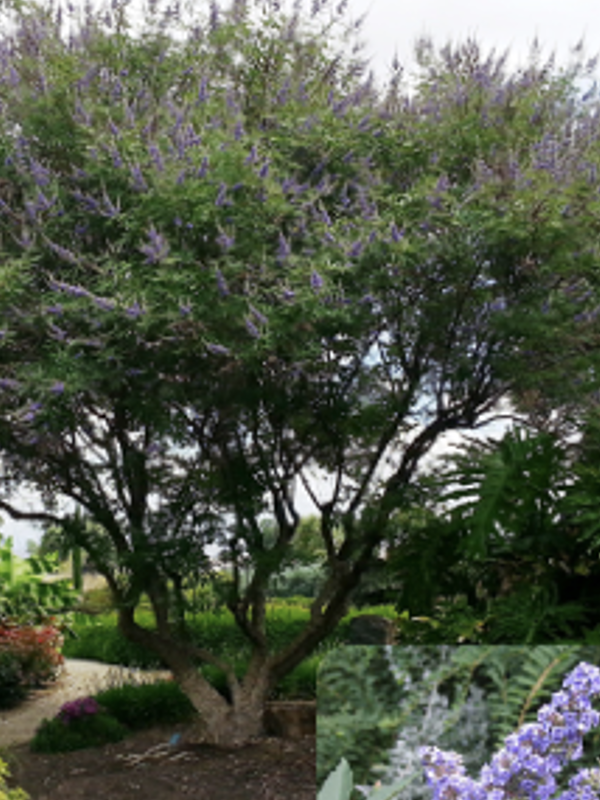
The Facts
-
-
Height: 8-10''
-
Spread: 5-8'
-
Sun: Full sun
-
Water: Medium
-
Soil: Well-drained
-
Growth Rate: Fast
-
Price in $ / 10 gallon container: $119
-
Vitex is a grand beauty throughout the Oklahoma landscape. One of the more attractive qualities is its versatile use. It can be kept in a more compact form as a shrub, trained as a single trunk tree or a stately multi-trunk tree. It makes a rather stunning addition to any yard or garden bed as it features aromatic, compound, palmate, grayish-green leaves with 5–7 lance‑shaped leaflets (each leaflet to 6” long) and tiny, fragrant, lavender to pale violet flowers appearing in loose panicles (to 12” long) in mid to late summer. Flowers are quite attractive to butterflies. One thing is certain, you won’t be disappointed in this tree!
Weeping Willow
The Facts
-
-
Height: 30-40''
-
Spread: 30-35'
-
Sun: Full sun
-
Water: Medium
-
Soil: Wet to well-drained
-
Growth Rate: Fast
-
Price in $ / 10 gallon container: $229
-
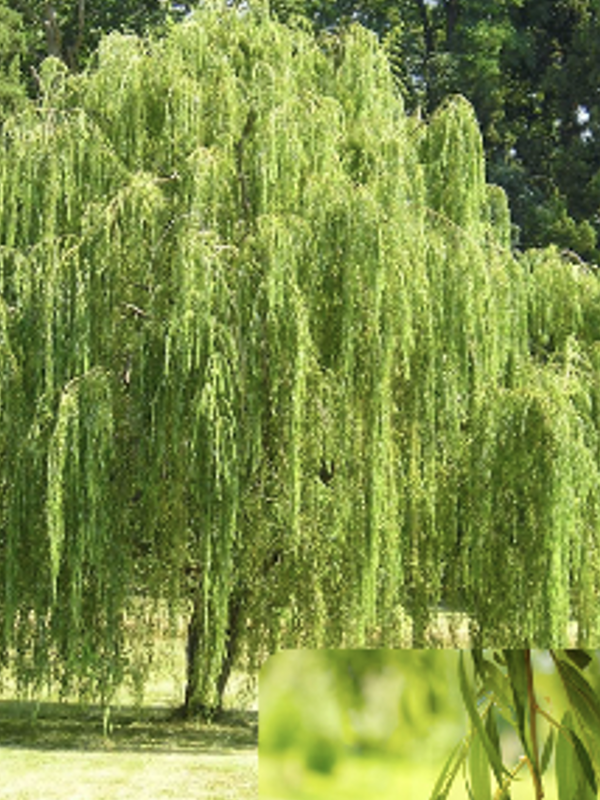
Often called ‘The Graceful Giant’, the Weeping Willow is an old favorite beloved by many. Its open crown of wispy, ground‑sweeping branches and long, slender leaves are a sight to behold. The tree’s yellow twigs and green foliage appear early in the season, often used as an indicator to the beginning of spring. Yellow flowers appear on short catkins in April and May. These are accented by the light green, narrow and finely toothed leaves.
The willow’s high adaptability and wide range of use make it well sought after. Its rounded shape and elegant stature and presence make it a fine focal point or accent for any landscape.
Wildfire Blackgum
The Facts
-
-
Height: 30-50''
-
Spread: 20-30'
-
Sun: Full sun
-
Water: Medium to wet
-
Soil: Well-drained
-
Growth Rate: Slow
-
Price in $ / 10 gallon container: $149
-
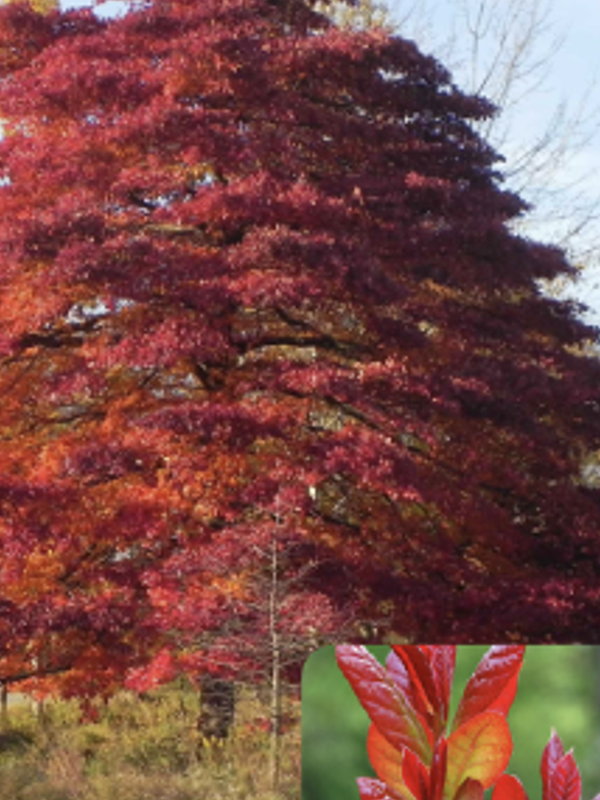
The Wildfire Blackgum bursts to life each spring with bright red foliage followed by clusters of white blooms that provide an excellent source of nectar for pollinators and birds. These blooms give way to dark blue fruits that, while edible, are very sour and usually left to the birds. The dark green summer foliage turns to shades of scarlet, yellow and orange for a brilliant fall display. Its red‑tinged branches add interest in the winter landscape.
High adaptability, relatively low maintenance and its many attractive qualities make this an excellent shade tree choice for lawns or along streets.
References
This list of references is not intended to be all-inclusive. Other sources may be utilized, and teachers are encouraged to make use of the very best instructional materials available. The following list contains references that may prove helpful during event preparation.
- CRISP Publications, 1200 Hamilton Court, Menlo Park, CA 94025-1427. 1-800- 442-7477.
FAX 650-323-5800.
- Professional Selling, Rebecca L. Morgan, ISBN 0-931961-42-4
- Sales Training Basics, Elwood N. Chapman, ISBN 1-56052-119-8
- Closing, Virden J. Thorton, ISBN 1-56052-318-2
- Professional Selling, Rebecca L. Morgan, ISBN 0-931961-42-4
- Ditzenberger and Kidney, Selling-Helping Customers Buy, South-Western Publishing Company,
Cincinnati, Ohio, 1992, 1-800-543-7972, ISBN 0538605316.
- Understanding Ag Sales, FFA.org
- ProSelling: A Professional Approach to Selling in Agriculture and Other Industries, W. Scott Downey, ISBN-13: 978-0978895211.
Past (national) CDE materials and other resources are available by logging in to FFA.org.
Note: Official FFA Dress is required for ALL parts of the contest. Contestants will
be allowed to have a personal calculator with them during the written test, but NOT
in other parts of the contest. Additional notes, books, or paper will not be allowed
in the contest room. Cellular telephones and other electronic audio or video devices
are not allowed. Scratch paper and other supplies will be provided as needed.